


We have proved in Sec. 3 that
 is a connected set. It is natural to ask whether the
Tetrabrot is also connected. Until now, the exploration of the Tetrabrot seems to confirm that the Tetrabrot is
connected. However, if we enlarge Fig. 7 in the centre of the Tetrtabrot above the zone B, we notice (see Fig. 24.A) that
there is a piece which seems to be disconnected from the main figure (Fig. 25 focuses on this piece).
Because we work with divergence layers and a computational approximation, we are far from knowing if the piece is
really unconnected or if there is point inside the piece which is also inside the Tetrabrot. However this is enough to
formulate a conjecture:
is a connected set. It is natural to ask whether the
Tetrabrot is also connected. Until now, the exploration of the Tetrabrot seems to confirm that the Tetrabrot is
connected. However, if we enlarge Fig. 7 in the centre of the Tetrtabrot above the zone B, we notice (see Fig. 24.A) that
there is a piece which seems to be disconnected from the main figure (Fig. 25 focuses on this piece).
Because we work with divergence layers and a computational approximation, we are far from knowing if the piece is
really unconnected or if there is point inside the piece which is also inside the Tetrabrot. However this is enough to
formulate a conjecture:
It is possible to translate the conjecture into a question about the geometry of the Mandelbrot set. For this, we need to prove the following lemma which is itself of interest:
Proof. By definition,

 with
with
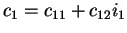 and
and
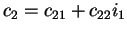 where
where
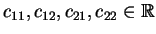 .
Now, if
.
Now, if  , we have
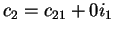 and
therefore,
and
therefore,
 whenever . Hence
 To continue the proof, we need to remark the following fact:


By definition,
 and
and
 are bounded
 if and only if
  ,
,
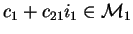 ,
and by the remark, it is also if and only if
,
and by the remark, it is also if and only if
 .
Hence, if we express
.
Hence, if we express
 ,
the Tetrabrot can be characterized as follows:
,
the Tetrabrot can be characterized as follows:

![\begin{displaymath}=\bigcup\limits_{y\in\mathbb {R}}\{[(\mathcal{M}_{1}-yi_1)\cap(\mathcal{M}_{1}+yi_1)]+yi_2\}.\end{displaymath}](img132.gif)
![\begin{displaymath}=\bigcup\limits_{y\in[-m,m]}\{[(\mathcal{M}_{1}-yi_1)\cap(\mathcal{M}_{1}+yi_1)]+yi_2\}\end{displaymath}](img133.gif)
 whenever
![$y\in[-m,m]^{c}$](img135.gif) .
This comes from the fact that
.
This comes from the fact that
 .
.
Moreover,

![$\forall y\in[-m,m]$](img138.gif) .
To see this, we just have to prove that
.
To see this, we just have to prove that
 is nonempty
because
is nonempty
because
 . In fact, the set
  is the algorithm for
the Mandelbrot set iterates, with the imaginary part in ``
is the algorithm for
the Mandelbrot set iterates, with the imaginary part in `` " fixed at
  . By the compactness and the
symmetry of the Mandelbrot set
. By the compactness and the
symmetry of the Mandelbrot set
 , there must exist
  such that
  ,
,
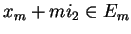 . Therefore,
because
is connected, we must have
. Therefore,
because
is connected, we must have
 .
.












 ,
,
 ,
,  and
and  are illustrated).
The ``box of divergence" is constructed as follows: let 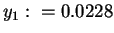 and
and 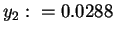 ,
,

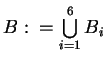
![\begin{displaymath}B_i:=\bigcup\limits_{y\in[y_1,y_2]}(L_i-yi_1-yi_2)\mbox{ for i=3,...,6}.\end{displaymath}](img167.gif)
 " is a side of the box; then the ``box of divergence" is
 .
.
First, we have to confirm that each ``" is a set where the algorithm for the Tetrabrot diverges.
This is possible with Lemma 3 and the assumption that  is not in the
Mandelbrot set.
is not in the
Mandelbrot set.
For  , by Lemma 3, we just need to prove that:
![\begin{displaymath}B_1\cap ([(\mathcal{M}_{1}-y_1i_1)\cap (\mathcal{M}_{1}+y_1i_1)]-y_1i_2)=\emptyset.\end{displaymath}](img172.gif)
![$B_1\cap ([(\mathcal{M}_{1}-y_1i_1)\cap (\mathcal{M}_{1}+y_1i_1)]-y_1i_2)\not=
\emptyset$](img173.gif) , we obtain that there exists
, we obtain that there exists  such that
![$z_1+y_1i_1\in[(\mathcal{M}_{1}-y_1i_1)\cap (\mathcal{M}_{1}+y_1i_1)]$](img175.gif) . However, this is impossible
because if
. However, this is impossible
because if
 we obtain that
 and this
contradicts the hypothesis.
and this
contradicts the hypothesis.
A similar proof is possible for  . The cases of
  ,
,  and
and  are also along the same lines.
For example:
are also along the same lines.
For example:
![\begin{displaymath}B_3\cap ([(\mathcal{M}_{1}-yi_1)\cap (\mathcal{M}_{1}+yi_1)]-yi_2)
=\emptyset\mbox{ }\forall y\in [y_1,y_2],\end{displaymath}](img182.gif)
![$y\in [y_1,y_2]$](img183.gif) and
and  such that
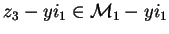
![$z_3-yi_1\in[(\mathcal{M}_{1}-yi_1)\cap (\mathcal{M}_{1}+yi_1)]$](img185.gif) .
However, this is impossible because if
.
However, this is impossible because if
 we obtain that
 and this contradicts the hypothesis. For
  , the same argument is possible if we remark that
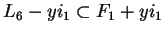
![$\forall y\in [y_1,y_2]$](img190.gif) .
.
Now, we have to confirm that each is on the same box.
For this, we will just remark the following fact:


 and
and  . Then each , for
  ,
touches and at their extremity. To be more specific and to confirm that the form a box, we have to
check directely with the exact coordinates given in the hypothesis of the theorem.
,
touches and at their extremity. To be more specific and to confirm that the form a box, we have to
check directely with the exact coordinates given in the hypothesis of the theorem.
Finally, we have to prove, with the assumptions of the theorem, that there is a point inside the
box  for which the algorithm for the Tetrabrot converges. For this, we remark that is
between
for which the algorithm for the Tetrabrot converges. For this, we remark that is
between  and
and  . Moreover,
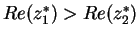 ; then we must have in the set
 a point
 .
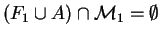
If not, by hypothesis, the Mandelbrot set would not be connected because
would be separated from by
.
If not, by hypothesis, the Mandelbrot set would not be connected because
would be separated from by  since
since
 .
.
Now, let
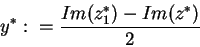
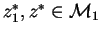 . We note that
 and
and
![$y^{*}\in[-1,1]\subset[-m,m]$](img207.gif) .
Then by Lemma 3,
.
Then by Lemma 3,
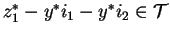 because
![$z_{1}^{*}-y^{*}i_1-y^{*}i_2=z^{*}+y^{*}i_1-y^{*}i_2\in
[(\mathcal{M}_{1}-y^{*}i_1)\cap (\mathcal{M}_{1}+y^{*}i_1)]-y^{*}i_2\subset\mathcal{T}$](img209.gif) .
Moreover,
.
Moreover,
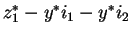 is inside the ``box of divergence" because
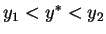 and is inside the rectangle formed by
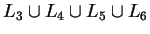 .
.
![\begin{displaymath}\mathcal{T}=\bigcup\limits_{y\in[-m,m]}\{[(\mathcal{M}_{1}-yi_1)\cap(\mathcal{M}_{1}+yi_1)]+yi_2\}\end{displaymath}](img113.gif)
 .
.