


In the previous section, we established a version of the Mandelbrot set in dimension four. Now, we want to
give a version of the Mandelbrot set in dimension three using the definition for
 .
The idea here is to preserve the Mandelbrot set inside
. Then, if we restict the
algorithm to the points of the form
.
The idea here is to preserve the Mandelbrot set inside
. Then, if we restict the
algorithm to the points of the form 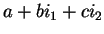 where
where
 , we preserve the
Mandelbrot set on two perpendicular complex planes and we stay in
, we preserve the
Mandelbrot set on two perpendicular complex planes and we stay in
 . This is the
first argument to justify the following definition.
. This is the
first argument to justify the following definition.
 .
.
We wish to give an illustration of the Tetrabrot in
. The next result will give
a manner to approach the Tetrabrot with the Euclidian norm in
 .
.
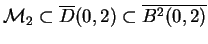 where
where
 .
Moreover, the radius
.
Moreover, the radius  is the best possible in each case.
 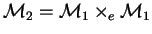 . Moreover,
and
. Moreover,
and
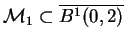 with a point of
 which touches the boundary of the unit disc [1]. Then,
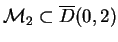 and
the radius is the best possible. Finaly, it is proven in [8] that
and
the radius is the best possible. Finaly, it is proven in [8] that
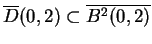 with points of
 which touche the boundary of
 .
.
Then, it is possible to compute the infinite divergence layers of the Tetrabrot from the number of iterations needed to have
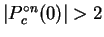 . We have to remark here that each divergence layer
will hide the others. For example, Fig. 2 is an illustration for the Tetrabrot of one of its divergence
layers in correspondence with the divergence layer illustrated in Fig. 1.A for the Mandelbrot set.
In fact, the Tetrabrot is inside Fig. 2. It is possible to see a part of the Tetrabrot (see
Fig. 3) if we cut a piece of Fig. 2. In Fig. 3, the colours are an illustration of the other
divergence layers. It is also possible to compute other divergence layers
(see Figs. 4, 5 ,6 and 7). Figure 7 begins to be close to the set we wish to approach; then
Fig. 7 with its cut plane gives certainly a good idea of the Tetrabrot.
. We have to remark here that each divergence layer
will hide the others. For example, Fig. 2 is an illustration for the Tetrabrot of one of its divergence
layers in correspondence with the divergence layer illustrated in Fig. 1.A for the Mandelbrot set.
In fact, the Tetrabrot is inside Fig. 2. It is possible to see a part of the Tetrabrot (see
Fig. 3) if we cut a piece of Fig. 2. In Fig. 3, the colours are an illustration of the other
divergence layers. It is also possible to compute other divergence layers
(see Figs. 4, 5 ,6 and 7). Figure 7 begins to be close to the set we wish to approach; then
Fig. 7 with its cut plane gives certainly a good idea of the Tetrabrot.
To define the Tetrabrot, we have put the last coordinate in ``
 " equal to zero. In fact it is possible to do
the same thing if we fix the last coordinate equal to a number different from zero. However, if we do that,
we lose the beautiful symmetry of the Tetrabrot. Figures 8 and 9 gives an illustration of this phenomenon for
two different fixed ``
" equal to zero. In fact it is possible to do
the same thing if we fix the last coordinate equal to a number different from zero. However, if we do that,
we lose the beautiful symmetry of the Tetrabrot. Figures 8 and 9 gives an illustration of this phenomenon for
two different fixed `` " with
  .
.
An interesting exploration of the Tetrabrot is now possible. For example Figure 10 is an enlargement of Fig. 7.A. It is also possible to be more specific. For example, Fig. 14 is an enlargement of 10.A and Figs. 11 and 12 are an enlargement of deep zones above the zone of Fig 7.A. Also, Fig. 13 is an enlargement of Fig 7.B. The colour in the background of Fig. 14 has been added to give a better 3-dimensional view. Each figure has been illustrated with a selected divergence layer and striations have been added to give an illustration of the ``level curves" of each figure.