


In this section, we want to give a version of the Mandelbrot set for the bicomplex numbers. First, we recall the definition of the Mandelbrot set for the complex plane:
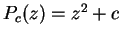 where
where
 and
and
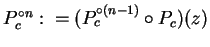 . Then the Mandelbrot set
is defined as follows:
. Then the Mandelbrot set
is defined as follows:
 .
When we take
.
When we take
 , we denote the Mandelbrot set by
 .
.
Figure 1 gives an illustration of the Mandelbrot set with some of its ``filled-Julia" sets. In fact, our figure
is a rotation by  of the original Mandelbrot set. This rotation will give a better vantage point
when we shall work on our version of the Mandelbrot set in
of the original Mandelbrot set. This rotation will give a better vantage point
when we shall work on our version of the Mandelbrot set in
 . Also, the colours
around the Mandelbrot set have been determined by the number of iterations needed before
. Also, the colours
around the Mandelbrot set have been determined by the number of iterations needed before
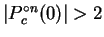 . This is well justified by the fact that the Mandelbrot set can also be characterized
as follows:
. This is well justified by the fact that the Mandelbrot set can also be characterized
as follows:
 [1]. Then, the colours give information about the manner in which the algorithm for the Mandelbrot set
diverges to infinity. This information will be almost the only possible one to approach our version
of the Mandelbrot set in dimension three.
[1]. Then, the colours give information about the manner in which the algorithm for the Mandelbrot set
diverges to infinity. This information will be almost the only possible one to approach our version
of the Mandelbrot set in dimension three.
We also recall the following beautiful property of the Mandelbrot set [3]:
Now, to give a version of the Mandelbrot set for the bicomplex numbers we have only to reproduce the algorithm of Definition 2 for the bicomplex numbers. This is the next definition.
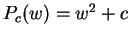 where
where
 and
and
 . Then the generalized Mandelbrot set
for bicomplex numbers is defined as follows:
. Then the generalized Mandelbrot set
for bicomplex numbers is defined as follows:
 .
.
The next lemma is a characterization of
 using only
. This lemma will
be useful to prove that
is also a connected set.
using only
. This lemma will
be useful to prove that
is also a connected set.
Proof. First, we prove that
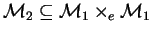 . Let
. Let
 such that
 is bounded
 . We have
![\begin{displaymath}P_{c}(w)=w^{2}+c=[(z_1-z_2i_1)^{2}+(c_1-c_2i_1)]e_1+[(z_1+z_2i_1)^{2}+(c_1+c_2i_1)]e_2\end{displaymath}](img58.gif)
 and
and
 .
Then,
.
Then,


 and
and
 are also bounded
. Then
are also bounded
. Then  ,
,
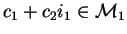 and
and
 .
.
Conversely, if we take
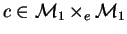 , we have
with ,
.
Hence,
and
are also bounded
.
Then
is bounded
, that is
, we have
with ,
.
Hence,
and
are also bounded
.
Then
is bounded
, that is
 .
. 
Proof. Define a mapping
 as follows:

 is clearly a homeomorphism. Then, if
  and
and  are connected subsets of
 we have that
 is also connected.
Now, by Lemma 1,
is also connected.
Now, by Lemma 1,
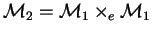 . Moreover,
by Theorem 1,
is connected. It follows, if we let
. Moreover,
by Theorem 1,
is connected. It follows, if we let
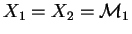 ,
that
is connected.
,
that
is connected.
 is connected.