


 where
where
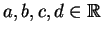 . The norm used on
 is
the Euclidean norm (also noted
is
the Euclidean norm (also noted
 ) of
) of
 .
We remark that we can write a bicomplex number
.
We remark that we can write a bicomplex number
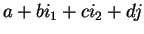 as
as
 where
where
 . Thus,
can be
veiwed as the complexification of the usual complex numbers
. Thus,
can be
veiwed as the complexification of the usual complex numbers
 and a bicomplex number can be seen as an element of
 .
Moreover, the norm of the bicomplex number is the same as the norm of the associated element
.
Moreover, the norm of the bicomplex number is the same as the norm of the associated element  of
.
It is easy to see [8] that
is a commutative
unitary ring with the following characterization for the
noninvertible elements:
of
.
It is easy to see [8] that
is a commutative
unitary ring with the following characterization for the
noninvertible elements:
 . Then
  is noninvertible
iff
is noninvertible
iff  and
and  or
or  and
and  iff
iff
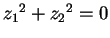 .
.
 has the following unique idempotent representation:

 and
and
 .
This representation is very useful because: addition,
multiplication and division can be done term-by-term. Also, an element
will be noninvertible iff
.
This representation is very useful because: addition,
multiplication and division can be done term-by-term. Also, an element
will be noninvertible iff 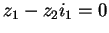 or
or 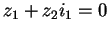 .
The next definition will be useful to construct a natural ``disc" in
.
.
The next definition will be useful to construct a natural ``disc" in
.
 is a
-cartesian set determined by
is a
-cartesian set determined by  and
and  if
if
 .
.
In [8] it is shown that if and are domains of
then
 is also a domain of
. Then, a manner to construct a natural ``disc"
in
is to take the
-cartesian product of two discs in
.
Hence, we define the natural ``disc" of
as follows [8]:
is also a domain of
. Then, a manner to construct a natural ``disc"
in
is to take the
-cartesian product of two discs in
.
Hence, we define the natural ``disc" of
as follows [8]:
 where
where  is the open ball
of
is the open ball
of
 with radius
  .
.